
If you work in P&C statistical reporting, you already have a routine: checking multiple regulatory websites for updates that might affect your next filing.
MACAR, NAIC, NCCI, State DOI sites — each with different layouts, different publishing schedules, and different ideas about where to put the important information.
Miss a data call announcement, circular, bulletin, or a quiet statistical plan revision, and you find out later — usually when a filing gets rejected or a deadline is suddenly urgent.
The problem isn’t that the information is hidden. It’s that it’s scattered, unpredictable, and mixed in with updates that likely have nothing to do with your filings.
So, we automated it.
We built a system that continuously monitors regulatory sources, detects new documents, extracts the content, and uses AI to determine what actually matters — what changed, who it affects, and what needs to be done.
Signal Matters More Than Volume
It’s easy to assume regulatory monitoring is a volume problem — too many documents to read. It isn’t.
Most carriers track a manageable set of sources. The real challenge is figuring out, quickly and consistently, whether a new bulletin actually affects their workflow.
A state bureau publishes a bulletin. Is it about statistical reporting requirements or life insurance tax filings? Is it a material change to a statistical plan or a routine administrative notice? Does it affect your lines of business and jurisdictions, or someone else’s? Does it have a compliance deadline?
Answering these questions manually, frequently, across various sources, is repetitive work that requires experience and consistency — and it rarely happens perfectly.
When it slips, it slips quietly.
How the System Works
The system runs a simple pipeline: discover, extract, analyze.
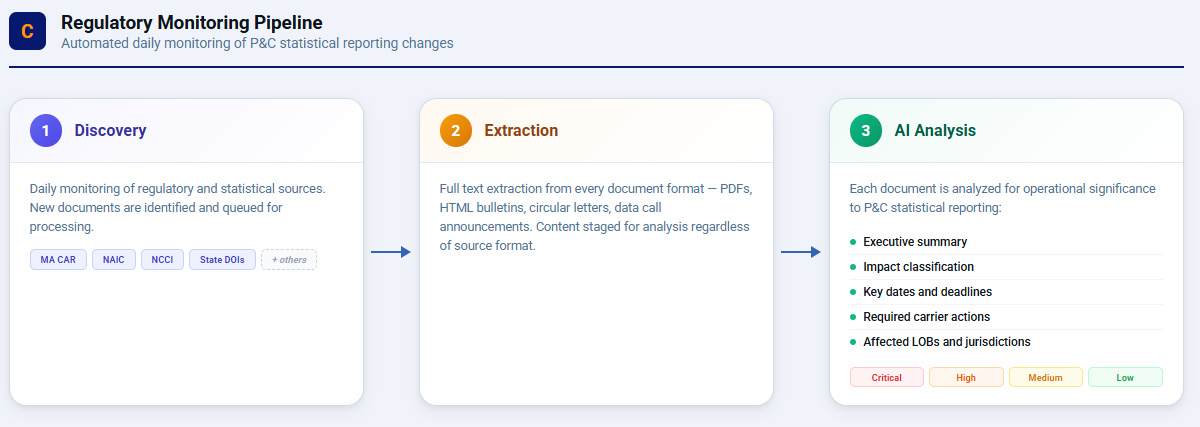
The regulatory monitoring pipeline: automated discovery of new documents, content extraction, and AI-powered impact analysis.
Discovery. We monitor key regulatory and statistical sources daily, including MA CAR, NAIC, NCCI, and multiple state insurance departments. Each source has its own site structure, its own document formats, its own publishing patterns. The system runs daily, discovers new documents, deduplicates against what it has already seen, and queues anything new for processing. Currently tracking 90+ regulatory documents across these sources, growing as new publications appear.
Extraction. Documents arrive in every format — PDFs, HTML bulletins, circular letters, data call notices. The system extracts full text regardless of format and prepares it for analysis.
AI analysis. For each new document, the system:
- Summarizes what changed and why it matters
- Classifies impact (critical, high, medium, low)
- Extracts key dates and deadlines
- Identifies required actions
- Tags affected lines of business and jurisdictions
Instead of scanning everything, teams see a prioritized feed with the most important items surfaced first.
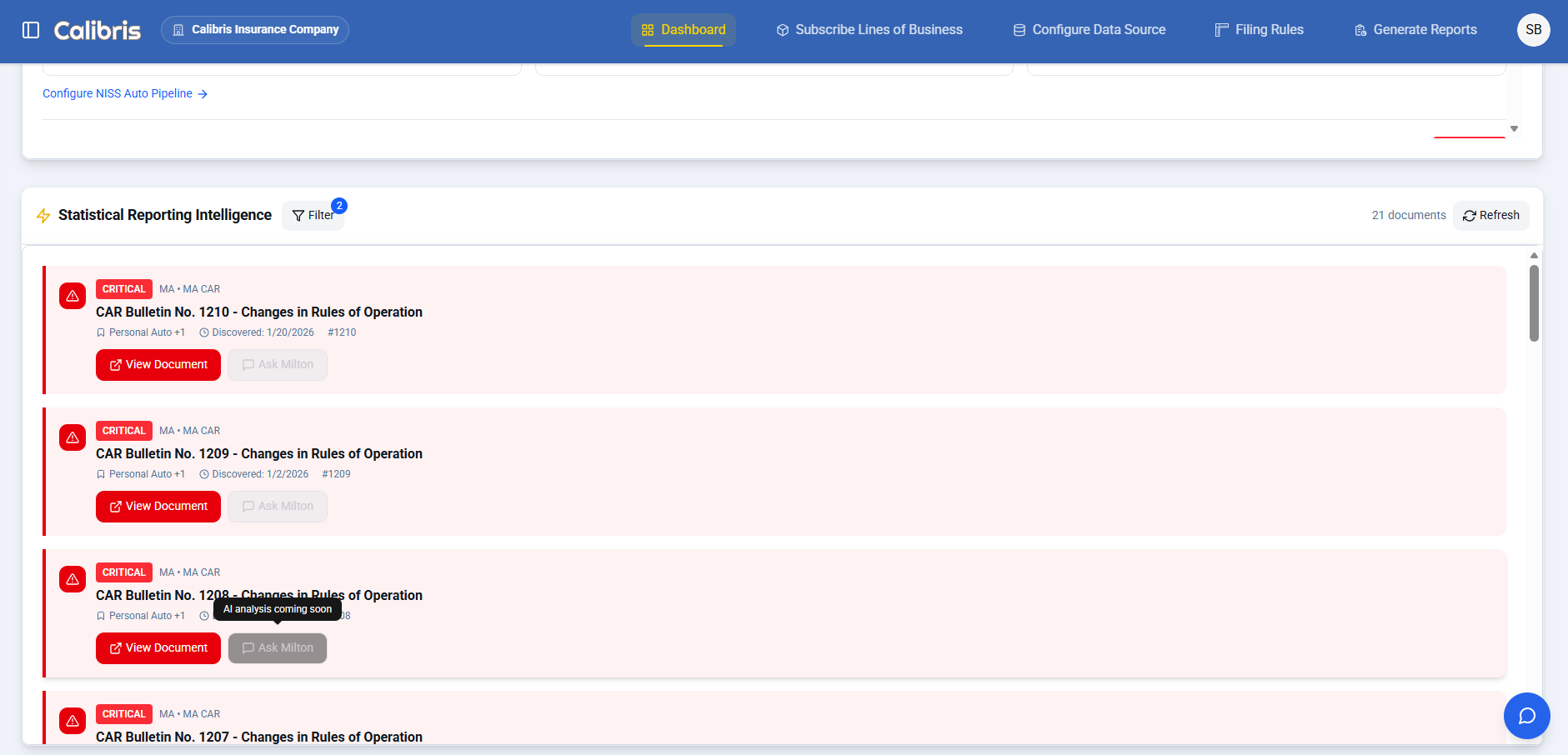
Critical regulatory changes surfaced automatically — with impact classification, source tagging, and one-click document access.
Focused on Statistical Reporting — Nothing Else
One design decision that sounds minor but matters significantly: strict filtering.
Regulators publish content across life, health, tax, surplus lines, and administrative topics. If you don’t filter aggressively, the feed becomes noise. This system is tuned specifically for P&C statistical reporting — statistical plans, data calls, reporting requirement changes, bulletins, circulars.
It’s not a general regulatory news feed. It’s built for the people who file statistical reports.
Automation That Eliminates the Miss
The pipeline runs daily, automatically scanning regulatory sources without human intervention. The real cost isn’t infrastructure — it’s missing a data call announcement, a statistical plan revision, or a compliance deadline buried in a routine bulletin.
Automated monitoring doesn’t just save time. It closes the gap where things slip through. Once automation is in place, the question stops being “can we afford to monitor this?” and becomes “why wouldn’t we?”
Where This Fits
This monitoring capability is part of Calibris.ai, a self-service platform for P&C statistical reporting. It connects directly to the same regulatory intelligence layer that powers our regulatory intelligence assistant Milton.
Monitoring tells you what changed. Regulatory intelligence tells you what the rules are and how to apply them.
Together, they move statistical reporting compliance from reactive to proactive — before deadlines are missed and filings fail.
This capability is evolving by design. As coverage expands and feedback loops mature, monitoring becomes more precise, more contextual, and more actionable — surfacing the changes that actually matter to your filings, not just everything that moved.
Once the system knows what changed, the next question is: what do we do about it? That’s where regulatory intelligence and automation converge.